Tuesday, January 8, 2019

Frost Cover Failure: Did They Live?

It's Flat and It's Freezing. Are they Frozen?

First there was this. Snow I should have prepared for, but didn't, flattened my frost cover. Then there was a spell of unusually cold weather for here, with the days at or barely above freezing and the nights well below freezing.

Left: Before
Right: After
I abandoned the leafy greens to their fate in the frozen wasteland and hoped the snow would be enough insulation to keep them from dying. I sat inside, sipping hot tea and snuggled with my cats, and waited.

Finally, after more than a week, the daytime weather warmed up a bit. The arches began to spring back up as the snow melted. It was looking like a snow snake's spine and I could see greens, although I couldn't tell if they were frozen dead greens or live greens.

Starting to Thaw, 10 Days Later
To see the thrilling finale of this cliffhanger ...
Read more!

Monday, January 7, 2019

Jute Erosion Mesh: Lawn Upholstery Part 2

It Finally Begins to Biodegrade


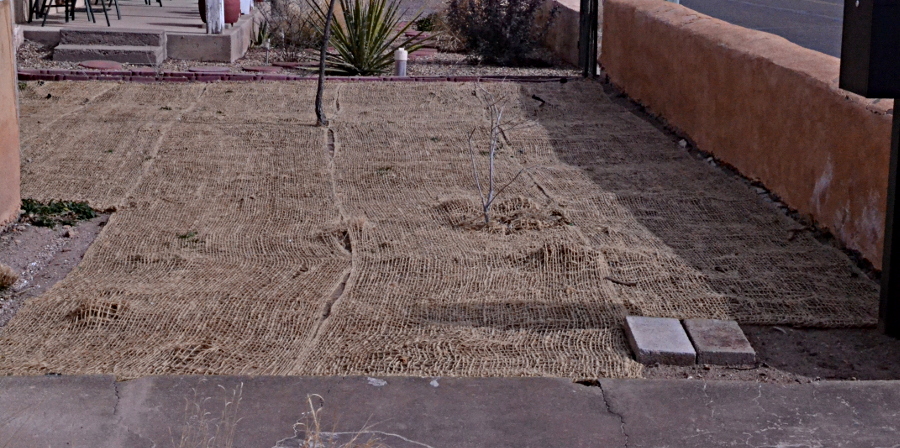
Almost 2 years ago, I covered the front yard with jute mesh to keep the grass seeds from blowing away or drying out. It worked as intended, but it's taking longer than I expected to degrade.

The mesh in the dryer areas of the yard (where the grass is thinnest) is still quite strong. The mesh where the grass was thickest has almost completely vanished. In a wetter climate, or if I had watered the grass more, it would have all vanished by now.

Raking the leaves this spring was tricky because the mesh was still strong enough to snag the rake tines. This winter the mesh is there, but although it looks intact it has most of its strength. I raked up small shreds and an occasional tangle of strings as I raked the dead grass and leaves.
The last of the erosion control cloth
 I'm tossing leaves, mesh and dead grass into the compost bins. By this time next year they will be ready for adding to the vegetable garden’s raised beds.


Read more!

Monday, December 31, 2018

Snow Is Heavy, Frost Shelter is Flat!

Engineering Failure: Will the Plants Survive?

We had several inches of snow overnight in late December. Light fluffy powder snow that squashed my frost cover!  More snow and sub-freezing daytime temperatures are forecast so I am going to wait until that is over before I dig down to see if the plants are alive.

It's flat.
 It's clear that I need some vertical support for the arches. I wasn't even thinking of possible snow weight, because high winds were the immediate threat. 

This on-line snow load calculator says there were 50 to 60 pounds of snow being held up by slender wires and some frost cloth.

Will the Plants Survive?

I hope so. I'll post when I find out. Read more!

Monday, December 3, 2018

How Do Frost Cloth Covers Trap Heat?


Garden Science

The leafy greens in the raised bed are thriving under the frost cloth tent. They've been planted out about a month and I am harvesting leaves. Harvest one leaf per plant and I can decorate a sandwich. Salads will come later.
One Month's Growth of Bok Choi

I always assumed that frost cloth worked by trapping heat under it, with stored heat from the ground keeping the air temperature above freezing. But I got curious and when I had the plants uncovered to water and weed them, I put a wireless remote thermometer under the tent.

Temperature? I recorded the temperature under the cloth and from an online personal weather station a block away periodically from 2PM until about 1PM the next day.
Read more!

Monday, October 29, 2018

Frost Cover Support: Rev 3.0 "Ladder Mesh"

The best version yet!

My first version of a frost cover support for winter vegetables was cobbled together in a hurry from available material with a cold front roaring down from Canada.  It was fast and effective but not convenient. The so-called "improved version" was not much better. This winter I took the time to think through the requirements for the supports before the freezes get here. Planning!  It works!

Improved Frost Cloth Support

Read more!

Monday, June 18, 2018

Killing Trees That Sprout From the Roots

All It Takes Is Patience, Herbicide (optional) and a Shovel


Black locust, (Robinia pseudoacacia),  Tree of Heaven, (Ailanthus altissima), and a few other shrubs and trees are notorious for coming back from the roots if you cut the main plant. In the wild they make large thickets, in the landscape they make a mess.

We removed a cluster of volunteer Ailanthus trees because they were wrecking the fence, endangering the neighbor's power lines and providing too much shade on the flower bed.

The First Attempt: Because I had heard horror stories about how hard these are to kill, I went 100% forest service style for removing them.  It involves hacking into the trunks with a hatchet and promptly applying glyphosate to the cuts at the "right time of year" to translocate the herbicide for an efficient kill.

It worked, they died that summer, and I had someone remove the trees down to stump level.  They are currently hidden by flowers, quietly rotting away and sprouting many inedible mushrooms. 
Ailanthus Stumps

Read more!

Monday, March 26, 2018

Save the Bees the Lazy Way

Just a short post - proving that less is more. If you mow less often, you have more bees. The USDA Forest Service and some partner researchers tested and found that mowing your lawn less frequently can significantly improve pollinator habitat. As long as you have clover and dandelions and other lawn flowers - more of a "meadow" than a putting green.


Native Bee on Clover in Lawn
The research team found that while mowing every 3 weeks resulted in as much as 2.5 times more lawn flowers (aka dandelions and clover) and greater diversity of bee species, the abundance of bees was greatest when home owners mowed every 2 weeks.


Read more!

Wednesday, October 25, 2017

Faster fall bulb planting

Just a quick post. If you have a lot of fall bulbs to plant, use a drill with a "spade" bit that is about half an inch wider than the bulbs you are planting.

Spade bits
Photo by Luigi Zanasi from Wikimedia

I planted over 100 small bulbs in a couple of hours by drilling into the dirt, then poking the bulbs root-first into the loose dirt.

This will wreck the bit because you will hit rocks, so don't use a top-quality woodworking bit. Any cheap bit will do.

Read more!

Monday, July 31, 2017

Tarantula Hawks: Gentle Giants of the Wasp World

You have probably encountered tarantula hawks on click-bait websites in a list of "most painful stings", "most bad-ass", or "biggest jerks of the animal world".  It's just fake news and sensationalism, except for the part about the painful sting. That's true.

Unless you annoy tarantula hawks sufficiently by grabbing them for research purposes or just because you are stupid, they ignore you and go about their business of feeding on nectar, and hunting spiders for wasp babies to eat. They don't just hunt tarantulas, any large spider will do.  I have had them run over my bare feet (it tickles) while they were searching my patio for black widows.

There were a dozen or more feeding on the flowers of a Vitex bush in my front yard so I grabbed the camera. These pictures were taken with a macro lens, my camera only a few inches from the wasp.  A couple of them bumped into me or the camera as they flew from flower to flower but I was just an inedible obstacle.
Female Pepsis grossa
The males find a good nectar source like the Vitex and hang out there in early June, waiting for females to show up. They might get lucky. 
Male

This species (Pepsis grossa) is amazing iridescent teal with rusty amber wings in New Mexico.  The Arizona variant is all black-teal iridescent, including the wings. The females have curled antennae, the antennae of the males are straight.

About that Sting

I have been stung once by a tarantula hawk, and yes it is intensely painful. It was a "could not move or talk" level of pain for the worst 5 minutes of my life, including the time I got a 600V jolt from a Nixie tube driver.  However painful, the sting didn't leave much of a trace once it was over. Compared to the hours of slightly less pain from a bark scorpion sting ... I'd take the wasp.

By briefly paralysing an attacker with pain, the wasp can often escape.  It's effective enough that very few insectivores are going to try to eat more than one.

See Also:

https://askentomologists.com/2015/09/27/please-stop-sharing-the-wasps-are-jerks-memes/   Read more!

Tuesday, July 25, 2017

Storm Damage, Mostly Hail

Along with three inches of rain in two weeks we had a few short hail showers.  The rain was welcome. The hail was not excessive, but the damage it caused might make a novice gardener think they had a mysterious disease or leaf-eating pests.

Here's the first example, a chile pepper with the typical irregular holes punched by hailstones.
Holes from Hailstones

And the second, which looks like some sort of a disease, but is just spots of freeze damage where a small hailstone landed on the tender tomatillo leaves, stayed there, and melted.
Freeze Damage from Hailstones
Read more!

Thursday, July 13, 2017

Establishing Squash Bees in Your Garden

By the time honeybees get their lazy striped butts out of the hive and start their daily commute to my garden, squash bees have been at work for a couple of hours pollinating my squash.  There is so little pollen left that the honey bees seldom bother to visit the blossoms.
Squash Bee with pollen-covered legs

Squash Bee with distinctive narrow-striped abdomen
How do they do it?  Squash bees live where they work, and turn the blooms into a singles bar. The male bees hang around in the blossoms, waiting for unfertilized females to show up.  Towards noon the males and any unfertilized females enter a male blossom and let it close around them.  At dawn, when the next blossoms are opening, the bees chew through the walls of their overnight hostel and continue their search for a mate.
Withered male flowers are overnight refuges
Instead of a long commute back to a hive with the pollen, a fertilized female squash bee digs a nest close to the squash plants.  She stuffs one of the chambers with pollen, lays one egg on the pollen and seals that chamber.
Squash Bee with pollen-covered legs
The fertilized females spend the afternoons digging nest chambers to fill with pollen the next day. They live in a nest until the chambers are all complete, then make a new one.
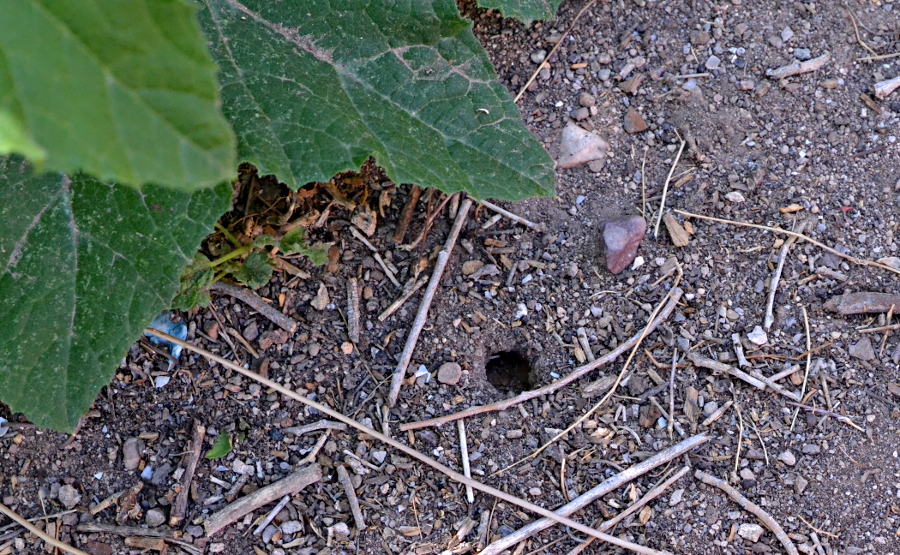
Squash bee nest hole
So how do you attract these wonderful creatures to your garden?  Plant squash, of course, and have some bare, untilled dirt next to the squash for the nests.  Read more!

Thursday, July 6, 2017

Watching Grass Grow: Buffalo 2.0 Is Now a Meadow

A meadow is grass with wildflowers ...and I have it!  At least in parts of the lawn, if you squint just right, I have fluffy clumps of grass with scattered flowers.
Jute mesh, new grass, and some wildflowers (Ratibida columnaris)
It's been slow to establish for several reasons:
  • We had a cooler spring than usual.
  • The summer rains have not come yet.
  • I did not till or amend the area before planting.
  • The seeds are not a select improved "turf" strain, it's just generic buffalo grass and blue grama grass. 
  • I fertilized very lightly and did not fertilize early.
  • Most of the wildflowers are perennials and will not bloom well this year. 
The erosion control mesh is doing exactly what I need it to do - when I water the mesh fills with water like waffles fill with syrup and it sinks in instead of running off.  I am watering daily to encourage the final grass seeds to sprout, with an occasional seep watering to get the roots to go deep.  I really need some rainstorms. Read more!

Wednesday, June 28, 2017

DIY Sweat Bands for Sound Protection Ear Muffs

Sound protection while you are using power tools is important.  The whine of a power saw or the roar of a chipper-shredder can permanently damage your hearing, and almost always leaves you with a headache.

I wear earmuffs.  But the foam ear pads produce sweaty ears!  I hate sweaty ears!  So I made these washable, cheap sweat-soakers out of cotton socks. They work well on my wireless headphones too, and don't block the movie sound. They lower the efficiency of noise cancelling headphones a bit, but it's still better than sweaty ears.

MATERIALS:
White cotton crew sock or socks, men's multi-size or large. Look for the highest cotton content as you can find in cheap socks.
Socks and Scissors

Read more!

Wednesday, June 21, 2017

Wasps for Caterpillar Control


Many people think the paper wasps and mud daubers are a dangerous garden pest that needs to be controlled.  In my view, they are excellent pest controllers, especially for caterpillars.  They catch insects and feed them to their larvae.
These cells will be filled with hungry baby wasps!
I was looking at my hollyhocks, looking for the insect that made web nests like this in leaves and ate the leaves.  Most of the webs were empty, because wasps were systematically locating the nests and eating the caterpillars. The wasps ignored me as they moved from leaf to leaf.
Caterpillars hiding in rolled leaf web.
One of the Painted Lady butterflies, Vanessa annabella West Coast lady
is the probably leaf muncher.  Mallows are one of their main host plants.

Wasps are also patrolling the Four O'Clocks, the tomatoes and the peppers, which have very little caterpillar damage this year.

When would I destroy a wasp nest? Nests in areas where they risk being bumped and bringing the wrath of the inhabitants on me are destroyed when I find them.  The first photo is of a nest that the wasp built in the garden shed, on my weed trimmer.  I destroyed it and hope she found a better place for her next effort. Read more!

Friday, June 16, 2017

Flowers! And Bugs!

Enough of construction and problem solving!  I have flowers to brag about ... Russian sage, hollyhocks, penstemons and gaillardia blooming between my patio and the fence in a gaudy mess.  
This is the traditional New Mexico style flower garden, where you plant a lot of things and let them fight for room. My long term plan is to extend this planting along the fence to the right, as time and available compost permit.

The Russian sage has dozens of bees, and an occasional butterfly.  These cream or white ones with spots are common.  An orange sherbet colored one taunts me and dodges the camera.
 

And on another wall, Zebra hollyhocks (Malva sylvestris) in a small planting area between patio and barbecue grill. There are also gaura and salvia for the hummingbirds.
 
Read more!

Monday, June 12, 2017

How to Grow your Own Ladybugs in 6 Easy Steps

A common question on gardening forums is "How do I attract ladybugs?".  It's easy. All you have to do is attract aphids.
  1. Have plants for the aphids. 
  2. Do nothing!
  3. Ladybugs will appear.
  4. Ladybugs lay eggs on the infested plants and eat aphids.
  5. Eggs hatch into aphid-eating larvae, grow up and make pupae.
  6. Adult ladybugs emerge from pupae and eat more aphids and lay more eggs.
Congratulations! You have grown ladybugs*.
Read more!

Monday, June 5, 2017

Climate, Micro-climates, and Nano-climates


This turned into an accidental demonstration of what micro-micro-climates are.  A micro-micro is a nano ... so maybe I'm showing nano-climates.  If you have a few plants that are unexpectedly struggling when the rest of the same variety are thriving, check for tiny differences in light and water.

EXAMPLE: Here are three young summer squash, looking quite water-stressed in the early afternoon.
Wilted
Less than 6 feet to the north, at the same moment, another three squash looking perky.
Unwilted
They were started and planted out at the same time, the seeds came from the same packet, the growing medium is the same home-made compost and silty sand, and they have the same length of drip tubing from the same manufacturer coiled around them.

The difference? The three to the north get light shade from a branch about 20 feet above them in the early afternoon. The stressed ones do not.

The solution? I added more drip tubing for the stressed ones.

I've seen nano-climates like this come from a window or wall reflecting light and heat, a septic tank's microbiological action warming the soil, or a change to a neighbor's landscaping giving more or less sunlight.

https://en.wikipedia.org/wiki/Microclimate 


Read more!

Monday, May 29, 2017

Watching Grass Grow: Buffalo 2.0 Update

Just a quick update on establishing the buffalo and blue grama lawn. It looked like this in early February, right after I spread the jute mesh and scattered the seeds.
February 2, 2017
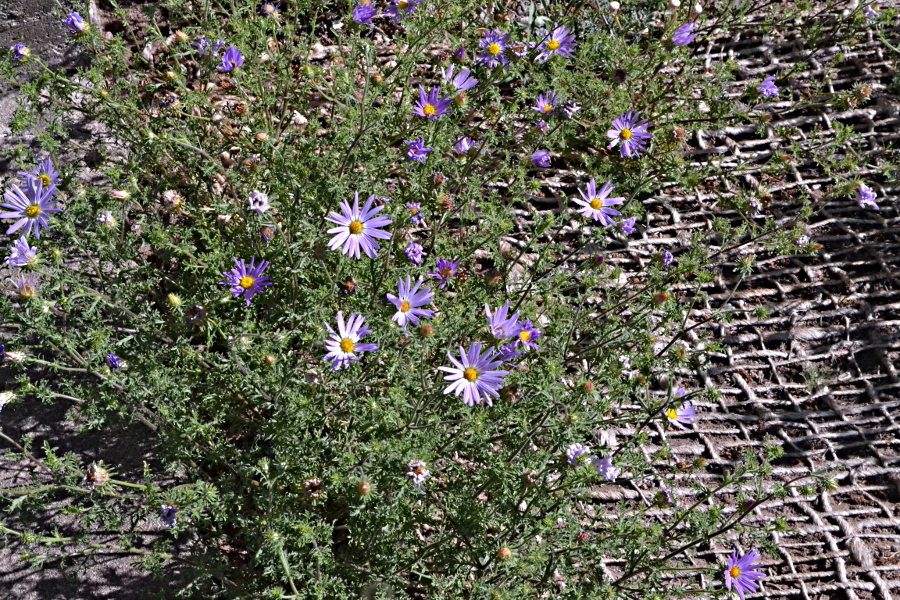
After way too much weeding and daily hand watering, by late May I had grass and an enthusiastic crop of native wildflowers.  Two annuals -  Tahoka daisy (Machaeranthera tanacetifolia) and sunflowers - are the main ones now. The perennial species are still very small.
May 27th
The daisies were not deliberately planted. They blew in from somewhere and I decided to keep them. They have a long bloom period, reseed easily, and attract a small white butterfly.
Tahoka Daisy
The native grasses don't grow very tall at first. They are establishing roots. When the summer rains come, I expect to see the buffalo grass sending out runners and the blue grama bunches get taller.
Tufts of grass
Read more!

Thursday, May 18, 2017

Composting rules I break, and why I break them

There are lists of what could/should and should not be tossed into a compost pile. I disregard most of them, because they make no biological sense. However, local conditions and ingredients affect my decisions.

What I don't compost, and why:
  • Eggshells
    Our soil has plenty of calcium, and the grackles or ravens rummage through the compost for shells, then carry the shells a short distance and drop them. It's not worth the mess they cause.
  • Cactus pads
    The fleshy part decays quickly, but the spines last forever in the compost. It hurts.
  • Palm fronds
    They are too fibrous to run through a chipper shredder, and the fibers last a long time, making the compost hard to turn or sift. 
    If you want to prune your palm trees, do it in time for Palm Sunday in the spring or Sukkot in the fall.  People will love you for donating fronds to their ceremonies.
What I compost that I'm "not supposed" to:
  • Kitty litter
    We use locally produced pellet fuel - compressed sawdust - as litter. After removing the feces because ewww! the urine-soaked sawdust composts easily.  I'm not worried about pathogens because they are my cats. They live with me, sleep on my bed and wander through my house.
  • Meat and leftovers containing meat or grease
    If you can compost an entire dead elk by piling sawdust over it, a few scraps of stew meat aren't going to make your compost pile die. 
    If I lived where the meat could attract scavengers such as bears or raccoons, I would keep most food scraps out of the compost.
Read more!

Friday, May 12, 2017

Weed Control: Herbicides 101, What Plants They Kill


Herbicides are chemicals used to control unwanted plants. All conventional or "organic" herbicides work by somehow interfering with plant growth. They may block photosynthesis and protein production, dry out the leaves, or destroy or inhibit root formation. Because different plant groups have different biochemical pathways, some herbicides can kill only one group and leave other groups unaffected. Other herbicides will kill a wider range of plants.

This means that you might be able to get rid of some plants and not kill the plants you want to keep.  But it also means you have to take the time to find the right herbicide, read labels and apply the herbicide correctly.
WARNING: If something will kill "weeds", it might also kill "flowers", "lawns", "vegetables", "shrubs", "trees", "animals", and you.
Read the labels before you buy a product or open the container. Follow the instructions. What has been sprayed can't be unsprayed.

READ THE LABELS: Yes, that means YOU!

A typical herbicide label has several pages of cautions and warnings and instructions.  The label will tell you how to safely handle the product, what plants to use the product on, and just as important, what not to use it on. You can read the labels online while you are deciding which product you need.
Label from typical lawn weed killer.
They tell you what NOT to apply it to because it will kill those plants.

There is also a long list of weeds it has been tested against that it will kill
if you apply it according to the package directions.

What are you killing, and for how long do you want it dead?

Classified by results, herbicides can be thought of as soil sterilizers, broad spectrum herbicides, broad-leaf herbicides, grass herbicides, and pre-emergent herbicides.  So your first step is to decide what effects you need, and identify the plants you want to kill. Then you can select which product of that class will work best for you.

Soil Sterilizer
A soil sterilizer prevents seed sprouting and regrowth from roots for a long period, months to years.  It usually kills existing plants as well.  This is the equivalent of "nuke it from orbit" for a gardener, and should be very carefully researched.

This is not the product you want to apply to clear the weeds from where you plan to put a lawn or vegetable garden.

Broad Spectrum Herbicide
Affects almost every plant you spray, but will not prevent seeds from sprouting, or only has a short effect on seed sprouting. These are useful for killing off everything and replanting with the desired species. With care they can be used around established plants without harming them.

Glyphosate is in this class, as is horticultural (20%) vinegar, and that stupid mix of salt, vinegar and dish soap. 

Broad-Leaf Herbicide
Affects most plants with two seed leaves, also known as broad-leaf plants, but does not affect plants with one seed leaf, such as grass and corn. This is what you get in the herbicides to kill weeds in lawns.


TIP: Not all plants with grass-like leaves are immune to this class of herbicide.  Some are not botanically a "grass" and others are just delicate varieties of a grass.

Grass Herbicide

This affect plants with one seed leaf or thin leaves, such as grass and corn, but does not affect plants with two seed leaves. These are useful for killing grass in your shrubbery and rose beds or an orchard.

Pre-Emergent Herbicide
This is often sold as a "weed preventer" because it sounds more appealing than "pre-emergent herbicide".  However it is labelled, it will prevent most seeds from germinating, so don't try to use it to keep weeds from sprouting in the vegetable bed or lawn you just seeded.


TIP:Timing is everything with pre-emergents. Applied too early or if there is too much rain and the herbicide might be washed below the level where the seeds are germinating. Applied too late and the weeds can be too mature to be affected.

On-Line References

https://en.wikipedia.org/wiki/Herbicide

http://extension.psu.edu/pests/weeds/control/introduction-to-weeds-and-herbicides/safe-herbicide-use 

http://extension.psu.edu/pests/weeds/control/introduction-to-weeds-and-herbicides/herbicides

http://www.ocregister.com/articles/plants-80501-weed-herbicides.html  Read more!