Showing posts with label experiments. Show all posts

Tuesday, January 8, 2019

Frost Cover Failure: Did They Live?

It's Flat and It's Freezing. Are they Frozen?

First there was this. Snow I should have prepared for, but didn't, flattened my frost cover. Then there was a spell of unusually cold weather for here, with the days at or barely above freezing and the nights well below freezing.

Left: Before
Right: After
I abandoned the leafy greens to their fate in the frozen wasteland and hoped the snow would be enough insulation to keep them from dying. I sat inside, sipping hot tea and snuggled with my cats, and waited.

Finally, after more than a week, the daytime weather warmed up a bit. The arches began to spring back up as the snow melted. It was looking like a snow snake's spine and I could see greens, although I couldn't tell if they were frozen dead greens or live greens.

Starting to Thaw, 10 Days Later
To see the thrilling finale of this cliffhanger ...
Read more!

Monday, December 3, 2018

How Do Frost Cloth Covers Trap Heat?


Garden Science

The leafy greens in the raised bed are thriving under the frost cloth tent. They've been planted out about a month and I am harvesting leaves. Harvest one leaf per plant and I can decorate a sandwich. Salads will come later.
One Month's Growth of Bok Choi

I always assumed that frost cloth worked by trapping heat under it, with stored heat from the ground keeping the air temperature above freezing. But I got curious and when I had the plants uncovered to water and weed them, I put a wireless remote thermometer under the tent.

Temperature? I recorded the temperature under the cloth and from an online personal weather station a block away periodically from 2PM until about 1PM the next day.
Read more!

Monday, June 5, 2017

Climate, Micro-climates, and Nano-climates


This turned into an accidental demonstration of what micro-micro-climates are.  A micro-micro is a nano ... so maybe I'm showing nano-climates.  If you have a few plants that are unexpectedly struggling when the rest of the same variety are thriving, check for tiny differences in light and water.

EXAMPLE: Here are three young summer squash, looking quite water-stressed in the early afternoon.
Wilted
Less than 6 feet to the north, at the same moment, another three squash looking perky.
Unwilted
They were started and planted out at the same time, the seeds came from the same packet, the growing medium is the same home-made compost and silty sand, and they have the same length of drip tubing from the same manufacturer coiled around them.

The difference? The three to the north get light shade from a branch about 20 feet above them in the early afternoon. The stressed ones do not.

The solution? I added more drip tubing for the stressed ones.

I've seen nano-climates like this come from a window or wall reflecting light and heat, a septic tank's microbiological action warming the soil, or a change to a neighbor's landscaping giving more or less sunlight.

https://en.wikipedia.org/wiki/Microclimate 


Read more!

Friday, March 31, 2017

Why you need a garden journal

I know what date I took a picture, because the camera dates them for me, but when did I plant those things? That's why I need to start a garden journal - if I'm going to make garden experiments, I need to document my projects better.
Nice lettuce on February 20, but when did I plant them?
Here's where I should wax rhapsodic over the joys of using a hand-bound journal with a vintage nib pen for my botanical musings, or launch a discussion of which garden journalling software works best for Mac, Windows and Linux or my smart phone. Or maybe discuss my search for an app that keeps my gardening data in the cloud, whatever and wherever that is.

But I'm not going there.

My main computer lives in my office and my gardening all happens outside or in the workshop. I have a not-so-SmartPhone and I don't want to risk my laptop in the garden.  I already have the property dimensions on graph paper, and the Weather Underground keeps track of weather history for me. I don't need to track every weed I pull, just a few significant dates like when I plant seeds and when I need to do certain tasks, such as check on the seeds I have chilling in the refrigerator.

The simplest solution is a calendar page with enough room to make notes, in a clipboard that hangs in the workshop. At the end of a month, the loose page will be archived into the big binder that has all my house notes.

Here's the journal page I picked, from a wonderful group I know nothing about except that they provide free calendar templates for Linux, Mac and Windows.  Download what you need and print them out.  If I need more room for notes in any month, I will staple a piece of lined paper to that month's calendar.
Monthly calendar with note area
2017 Calendar Template Download 
And here it is, in front of my extremely sophisticated grow light system. The upcycled lettuce and pastry containers have soil blocks and seedlings in them.  ("Upcycled" sounds so much better than scavenged.)
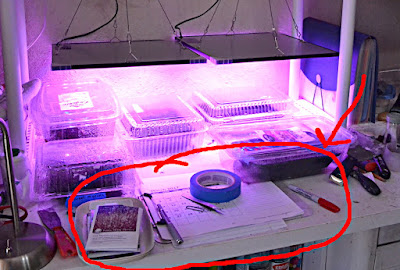
Garden journal at work, collecting notes.
Read more!

Wednesday, February 15, 2017

Watching Grass Grow: The Return of the Buffalo

We had heat-tolerant buffalo grass in Phoenix and loved the low maintenance and toughness of it.  The landscape plan in New Mexico includes a xeriscape "meadow" of grasses and wildflowers.  Instead of the plugs, I'm using seeds of a buffalo grass variety better adapted for high desert, mixed with blue grama grass and a small number of other native grasses for accents.
Buffalo cow and calf enjoying a stroll in Yellowstone National Park

The front yard was mostly neglected bare dirt. After the visible weeds were killed off, the seeds were scattered over the bare dirt and covered with jute erosion control mesh as a mulch to keep the seed from blowing all the way to El Paso. When the weather warms up, I'll be watering every few days until the grass is established. I'll also be pulling weeds.

Seed Sources

Western Native Seed of Coaldale Colorado
Xeriscape Lawn Mix, 70% buffalo grass/30% blue grama grass
Because the grama grass seeds are smaller than the buffalo grass, it's probably equal quantities of each seed.
Xeriscape Wildflower Mix  A whole bunch of stuff in this.

Prairie Moon Nursery was the source for some of the accent grasses and wildflowers. I'll be writing about them later.  I put about half of the grasses from prairie Moon into the main lawn mix and the rest will be planted as drifts or specimens

Also, I had grass and flower seed collected from along the roads here that I blended into the grass or flower seeds before scattering them. It will be interesting to see what grows. Read more!

Sunday, February 5, 2017

Late winter planting to avoid the spring rush?

The experiment - I'm exploring the possibility of starting leafy greens in late fall and "storing" them in the garden under a frost cloth during the winter so they are out of my way when I need the seed starting space for chiles (we have our priorities in this state).
If it works, I can have a three-planting rotation for leafy greens: Late fall for harvest in early spring, late spring for harvest in spring/summer, late summer for harvesting into the winter.

I planted out seedling butterhead lettuce in soil blocks December 3. Earlier plantings of chard, kale, bok choy and leaf lettuce - set out in beginning in early November - are looking happy and putting out leaves.  I've been harvesting since mid-January.  They are under a frost cloth tent, but it's not heated.
Bok Choi, planted as seedlings in December
Read more!

Tuesday, November 29, 2016

Dealing with Weed Seeds in Compost


This accidentally turned into a nice demonstration because the various leafy greens germinated in their soil blocks at different times and were planted out at intervals of a few days.

My compost method is known as "slow" or "cold" composting.  This pile it and forget it method doesn't produce enough heat to reliably kill weed seeds.  Some will die of old age before the compost is used, but others will survive.

That means my just-filled raised beds were filled with unsprouted weed seeds. They sprouted as soon as they got  light and moisture, leaving me with a weedy mess of a vegetable bed like this. 
 
Weedy mess and transplanted chard seedlings
It will get worse every day unless ...
Read more!

Tuesday, November 22, 2016

Fluid Seeding, aka Cornstarch Gel Germinating

Several sites recommend using a cornstarch gel for planting out delicate barely germinated  seeds, or as a medium for germinating them.  It's used because after a seed has germinated artificially it will continue to grow even though it's too cold for them to germinate in the ground.

In an area with a short growing season you can gain a couple weeks of growing time by pre-germinating. 

The claim is that the gel and sprouted seeds can be squeezed from a bag into the prepared seed bed without damaging the delicate new roots.  If you are germinating in a dish of gel, you can spoon a sprout and some gel and place it where you want it.  The gel cushions the roots during transfer and provides a small reservoir of moisture for the first few days.

I tried germinating seeds on a dish of gel because my success rate when planting directly is usually poor.  Keeping a garden plot damp during a seedling's delicate early days is not easy in the arid Southwest.
Read more!