Thursday, April 30, 2009

Buffalo Grass v.s. Bermuda Grass (what to kill)

If you are replacing a Bermuda grass lawn with buffalo grass, you will have to kill any Bermuda that survived the pre-planting attempts to kill it. There will be sprouts for several months, maybe even years, depending on how long the Bermuda Grass had to become established. You can either dig out the sprouts, removing as much of the roots as possible, or carefully spray them with a grass-killing herbicide. I'm doing both, depending on how close the Bermuda grass sprout is to the buffalo grass.

They are both grasses, and both spread by runners across the soil. So how do you tell them apart? Look at the way the leaves grow.

This is Bermuda grass. The leaves come out almost opposite to each other. As the runner gets longer, a new pair of leaves will push out of the growing tip.


This is buffalo grass. Only the leaves at the tip are paired. The leaves on the runners are not paired. The growing tip will leave one of the blades behind on the stem as the runner gets longer.


More Bermuda grass. It typically has the blades parallel to the ground, flat side up to catch as much sun as possible. The leaves are mostly in pairs.


More buffalo grass. It tends to send the sprouts upward instead of flat to the ground.


Read more!

Monday, April 27, 2009

Watching Grass and Weeds Grow : Week 5

This week I was watching the weeds. The constant moisture that it takes to get the grass to spread is encouraging a huge crop of weeds. I identify spotted spurge, wild chamomile, tomatillos*, lots of junk grasses, annual bluegrass, cranesbill and others. I don't like to use herbicides, but there are too many weeds to control by hand pulling and using the scuffle hoe would rip out the spreading grass runners.

My recommendation for anyone trying to establish a buffalo grass lawn - or any kind of lawn - would be to start in the fall. Prepare the soil then. Water it well in early spring to get the annual weeds to sprout so you can kill them with glyphosate before the grass is planted, and use a pre-emergent to get the stragglers. I didn't, for compelling scheduling reasons, and am having to compensate by applying chemicals I don't normally use.

After a lot of researching what works for buffalo grass (there is not much information yet) ... it was time for some chemical warfare against the weeds with a broadleaf weed killer that has a mix of 2, 4 D (2,4-Dichlorophenoxyacetic acid), Mecoprop (methylchlorophenoxypropionic acid), and Dichlorprop.

As usual, I read the label, used the lowest recommended dose and followed ALL the instructions carefully. Buffalo grass is reputed to be more sensitive to broadleaf weed killer than some turf grasses, especially if the herbicide is applied on a hot day. I sprayed early in the morning on a day when the highest temperature was predicted to be below 90° F. I'm now watching for the weeds to start dying.

Grass News: In a the small area we planted with 9-inch spacing to use the few extra plugs, the runners from the clumps are touching the other clumps. In the areas with 18-inch spacing, a few runners are a foot long. If your budget can handle the extra expense, I recommend buying enough plugs for 9-inch spacing.

*Perhaps tomatillos are not considered to be a weed, but a couple hundred tomatillos sprouting in the lawn takes them out of the garden vegetable category. The seeds may have been spread by birds, or were in the compost we spread. Read more!

Monday, April 20, 2009

Watching Grass Grow: Week 4

The grower, Todd Valley Farms in Nebraska, assures me, "As soon as the heat hits the plugs will explode". But they didn't define "heat". Is it 70°F (warm in buffalo grass's native area), 80°, or what? This month has seen daytime high temperatures from the low 60s to the low 90s, with as much as a 30° jump or drop between days. Overnight lows are in the 40s and 50s.

That's typical for Arizona at this time of year.

The grower didn't define "explode" either. How fast can this stuff grow in a week of 90° days with a generous helping of water and nitrogen-rich mesquite bean compost? I wish I had time-lapse photography for this, because the forecast is for increasingly warmer weather and maybe 100° by Tuesday.

There are more runners than last week, but it's not obvious unless you look carefully. Read more!

Saturday, April 18, 2009

Why "Affiliate" Marketing Sucks!

Affiliate marketing must sound fabulous to a business - pay a small commission and you multiply your web presence by hundreds or thousands of pages, all pointing back to your site and your products. Instead of a tiny hook with bait, you have a bloody trawler net. There's no way customers can escape your reach.

To the affiliates, it must sound like a great deal too. Just put up a web page, using content provided by the merchant, sit back and watch the commissions roll in.

To the would-be buyer, however, it sucks! It just plain sucks! Here's my latest experience with on-line shopping and affiliate marketing. I needed a part for my truck - nothing big, just a new knob for the AC control switch.

Can I find a knob for the AC switch using Google? No! There were hordes of affiliate sites clogging the search engines, each claiming to have the part I need, but they seldom even had a link to a site that perhaps might have had what I needed. The affiliates prevented me from getting to the site they are affiliated with by their sheer numbers.

It's like wading through a mob of aggressive panhandlers near the Berkeley BART station ... all of them saying "ME! ME! CLICK ME DAMMIT!"

Let's not even talk about the "AdSense optimized" sites that had all the keywords I was looking for, but no products, just more ads. Many of them may be ex-AdSense sites by now, because I took URLs and hope Google will kick butt.

Frustrated by the clogs of affiliates, all selling the same knobs - I do not want a skull on my AC switch knob, really I don't, nor does a blue glow-in-the-dark Iron Cross appeal to me - I finally searched Froogle for: AC switch knob chevy

I found one! Just ONE parts dealer, no affiliates, no swarming click-begging affiliates, and the seller didn't pay a commission to anyone. I'll definitely be using Froogle instead of Google from now on.

Sod off, you annoying affiliates!

Read more!

Wednesday, April 15, 2009

Raiders of the Lost Artichoke

Urban Quail-boy up to no good!

I have mixed feelings about the flocks of Gambel’s quail that roam the neighborhood. On the one hand, they are handsome native birds, eat weed seeds, and I know I should be honored to have the mob strolling through the landscaping. On the other hand, they devour the fresh tender leaves from my vegetables, make dust wallows in the cilantro patch, and dig holes in the mulch. Here’s one of them in the spring, deciding which part of the landscape he’s going to attack next.

It is definitely a male - notice the rust-colored head, black belly patch and large topknot feathers.

The tomato cages are partly for future support of the eggplant, but mostly to prevent the dogs from tag-team wrestling on top of them while the plants are small. By July the eggplant were 3 feet tall and bearing a dozen or more fruits a week.

The flowering plant in the background is called Desert Mallow or Globe Mallow (Sphaeralcea ambigua). It’s a weed, but a pretty one. In addition to the salmon color seen here, which is the most common color, other plants bloom in white or shades of lavender, pink, orange or an almost-red.

Read more!

Monday, April 13, 2009

Watching Grass Grow: Week 3

Rough week for plants - we had a late winter storm run through with pounding rain, some hail and strong winds. The grass is still alive! Although a few plugs are wispy and wan, I still have 100% survival of the 600+ planted plugs.

There are some visible results to report. Some of the plugs have sent out fresh runners 6 to 9 inches long. The runners are easy to overlook, because they are thin and wiry, but the runners are rooting and sprouting blades of grass from their nodes. Other plugs are sending up fresh blades and increasing the density of the clumps.

Grass Runner, bolting for freedom


The various tree seeds continue to sprout in the lawn area, as do the weeds. The quail are earning their keep: fresh baby cheeseweed is one of their favorite foods. They inspect the lawn area that is farthest from the house and eat many of the weeds. That leaves me to weed the more exposed areas where the quail don't want to feed.

The Bermuda grass is still sprouting, despite glyphosate treatment of every sprout I see. Read more!

Friday, April 10, 2009

John Evelyn's Kalendarium Hortense - February

February is the month for preparing the orchards, the fruit trees in the walled gardens, and planting the hardiest vegetables and flowers.

FEBRUARY
Hath xxviii days, — long 9h — 24m
Sun rises 7h — 13m — Sets 4h — 45m

To be done
In the Orchard and Olitory-Garden.

The rising and setting of the sun was computed for the first of the month, for London.
PRUNE Fruit-Trees and Vines as yet; for now is your Season to bind, plath, nail and dress, without danger of Frost : This is to be understood of the most tender and delicate Wall-Fruit, not finish'd before; do this before the buds and bearers grow turgid; and yet in the Nectarine and like delicate Mural-Fruit, the later your Pruning the better, whatever has been, and still is, the contrary Custom.Bind, plath, and nail = fastening the trees to their walls.

Dress = covering the pruning scars, usually with pitch or wax.

He is opposing the custom of pruning frost-tender trees early.


And let your Gard'ner endeavour to apply the Collateral Branches of his Wall-Fruits, as near as possible he can (without Violation and unnatural bending and reverting) to the Earth or Borders; so as the Fruit (when grown) may almost touch the Ground : The rest of the Branches following the same Order, will display the Tree like a Ladies Fan, and repress the common exuberance of the leading and middle Shoots, which usually make a too hasty an advance : a Gard'ner expert in this, and the right Art of Pruning, may call himself a Workman sans Reproch.
A well-shaped espalier fruit tree can be a very productive tree, and in the walled gardens of the time, would have been beautiful in bloom. Evelyn prefers the fan shape, but various arrangements of parallel and diagonal branches were created.
Remove Graffs of former years Graffing. Cut and lay Quick-sets; and trim up your Palisade Hedges and Espaliers. Plant Vines as yet, other Shrubs, Hops, &c.
Remove last year's grafts that didn't succeed.
Set all sorts of Kernels and stony Seeds, which Field-Mice will certainly ruine, before they sprout, unless prevented : Also sow Beans, Pease, Rouncevals, Corn-sallet, Marigold, Anniseeds, Radish, Parsenips, Carrots, Onions, Garlick, &c. And plant Potatoes in your worst Ground.Rouncevals = a variety of pea, known for its large size.
Corn-sallet = Valerianella olitoria, a plant used much like lettuce
Anniseeds = Pimpinella anisum, or anise. The leaves were used in salads, stews and soups.

Now is your Season for Circumposition by Tubs or Baskets of Earth, and for laying of Branches to take root. You may plant forth your Cabbage-Plants.Circumposition = planting heavily pruned trees in containers. It produces a dwarfed tree.

Laying of branches = propagating plants by burying the partly severed branch until it roots at the cut, then separating it from the parent.

Plant forth = transplanting seedlings or young plants that were started indoors.

Rub Moss off your Trees after a soaking Rain, and scrape, and cleanse them of Cankers, &c. Draining away the wet (if need require) from the too much moistned Roots, and earth up those Roots of your Fruit-Trees, if any were uncover'd. Continue to dig and manure, if weather permit. Cut off the Webs of Caterpillars, &c. from the Tops of Twigs and Trees to burn. Gather Worms in the Evening after Rain.Rub Moss = Moss was thought to damage the trees.
Cankers = fungal growths, or infected gouges in the bark.
Covering the roots is part of the practice of ablaqueation, first mentioned in January.
Manure = to fertilize
Webs of caterpillars = the protected egg masses of a tent-caterpillar.
Gather worms = at this time, and well into the 19th century, earthworms were considered a garden pest. Charles Darwin's book, The Formation of Vegetable Mould Through the Action of Worms, With Observations on Their Habits, published in 1881, sold even better than On the Origin of Species during Darwin's lifetime.

Kitchin-Garden Herbs may now be planted, as Parsley, Spinage, Onions, Leeks, and other hardy Pot-Herbs. Toward the middle or latter end of this Month, till the Sap rises briskly, graff in the Cleft, and so continue till the last of March; they will hold Apples, Pears, Cherries, Plums, &c. the New Moon, and the Old Wood is best. Now also plant out your Caulyflowers to have early; and begin to make your Hot-Bed for the first Melons and Cucumbers to be sow'd in the Full; but trust not altogether to them. You may all this Month, and the former, have early Sallets on the Hot-Bed and under Glass Frames and Bells. Sow Asparagus. Lastly, Half open your Passages for the Bees, or a little before (if the Weather invite;) but continue to feed weak Stocks, &c.Herbs = in this context, vegetables that were used in soups and stews.

Graff in the cleft = Grafting small twigs into a split branch or trunk of the host tree.

There was competition among the upper class to have the earliest of anything edible or flowering. They used weather protection for tender plants, including hot-beds, cold-frames (a planting box with glass top to trap heat), and glass bells to cover individual plants.

Open your Passages = the bees were shut into the hives for the winter by blocking the exits.

Fruits in Prime, and yet lasting.

APPLES

Kentish, Kirton, Russet, Holland Pippins; Deux-ans, Winter Queening, Marigold, Harvey sometimes, Pomewater, Pome-roy, Golden-Doucet, Reineting, Lones Pear-main, Winter Pear-main, &c.

PEARS

Bon-Chrestien of Winter, Winter Poppering, Little Dagobert, &c.


FEBRUARY

Hath xxviii days, — long 9h — 24m
Sun rises 7h — 13m — Sets 4h — 45m

To be done
In the Parterre and Flower-Garden.


COntinue Baits, Vermine-Traps, &c.Sow Alaternus seeds in Cases, or open Beds; cover them with Thorns that the Poultry scratch them not out. Sow also Lark-Spurs, &c. Now and then air your hous'd Carnations, in warm Days especially, and mild Showers, but if like to prove cold, set them in again at Night.
Alaternus = Rhamnus alaternus, or buckthorn, an evergreen shrub used in making hedges.
air your hous'd Carnations = take the pots of carnations outside in warm weather.
Furnish (now towards the end) your Aviaries with Birds before they couple, &c. And hang up materials for them to build their Nests with.
Note, That such Birds as feed not on Seeds alone, should be separated by a Partition of wyre, from those who feed on bruised Seed, Pastes, fleshy or pulpy Mixtures; as the Sky-Lark, Wood-Lark, Throstle, R. Redbreast, &c.
Keeping song birds was common, and they were also caught for food. I'm not certain if these were to be for exhibition or for eating.

Flowers in Prime, or yet lasting.

Winter Aconite, single Anemonies, and some double, Tulips, Præcoce , Hyacinthus, Stellatus,Vernal Crocus, Black Hellebore, single Hepatica, Persian Iris, Leucoium Bulbosum, Dens Caninus three leav'd, Vernal Cyclamen white and red, Mezereon, Ornithogal. max. alb. Yellow Violets with large Leaves, early Daffodils, &c.


The punctuation gives two possible lists. Perhaps he meant three kinds of tulips (præcoce, hyacinth, and stellar). Or, taking out a different comma, he meant tulips, early hyacinths, and the species tulip called "stellar tulip".

Leucoium Bulbosum = Leucojum vernum, spring
snowflake.
Dens Caninus = Erythronium dens-canis, the "dog-toothed violet". It is a member of the lily family.
Ornithogal
. max. alb. = Star of Bethelehem (Ornithogalum arabicum or O. Umbellatum)

Read more!

Wednesday, April 8, 2009

Watching Grass Grow: Week 2

Still no change. None of the plugs have died, but none have obviously increased in size. I know the plugs are probably sending roots deep and wide, but I want to see grass. I want it now!


The doves, quail, curved bill thrashers and towhees are going nuts in the planted area, feeding on bugs and freshly sprouted weeds. The beak marks are so dense in some areas it looks like someone in golfing shoes did a tapdance.

The organic matter we used in the lawn prep was several cubic yards of home-made compost, much of it shredded mesquite and palo verde prunings, dropped leaves, and any bean pods the birds didn't eat. The result is dozens of baby trees popping up as the constant moisture encourages the seeds to sprout. Easy to spot, and easy to pull.


There are also some surviving Bermuda sprouts emerging. We couldn't wait until the Bermuda was completely out of dormancy and active enough to finish the grass killing that started last fall because it would have been too hot for good shipping and planting weather. The crew that installed the sprinklers stripped the sod, and I'm prowling the lawn area with a small spray bottle of glyphosate to kill the sprouts as they emerge.

I didn't use a pre-emergent, which probably wouldn't have worked well anyway. They tend to get washed out of the effective prevention zone after a few waterings, and this area is moist at least 12 inches deep and getting watered twice a day. A few of the ubuquitous Phoenix weeds are sprouting. The cheeseweed has to be spotted quickly because it can make two leaves, produce one flower and make a couple hundred seeds.
Read more!

Tuesday, April 7, 2009

Growing and Cooking Tomatillos

Tomatillos (Physalis ixocarpa) are also called "ground cherry", or "husk tomato". They are a distant relative of the tomato, with a similar flower and fruit, except that the fruit is protected by a papery husk. The most common variety is the green-fruited one, but occasionally you may see a variety that turns purple when ripe. These plants are critical for the "salsa verde" of Mexican cooking.

I have heard that you must have at least two plants before they will set fruit, but have not been able to confirm that rumor. I have three of them because I want lots of tomatillos to cook with. Growing these is easy - just pretend they are tomatoes and you can grow them anywhere. If nurseries in your region don't sell them as started plants, seeds are available on the Internet. They need full sun even in Arizona, moist soil, and some fertilization.The plant is a sprawler, so I used a tomato cage to try to keep the fruit off the ground. By mid-July they had outgrown the support and the sprawling branches were firmly rooted into the ground at some of the leaf nodes. Now (late September) the three plants are almost filling over an 8x6 foot raised bed and covering a couple of feet on either side of the bed. Keep this tendency in mind - it could engulf slower-growing plants. Next year I may try them in big pots near the pool.

It is not easy to tell when they are ready to harvest because you can't see them inside the husks, but they are edible at any stage. They start out tart, like a green apple, and get progressively sweeter as they grown and ripen. The best stage for most recipes is a light apple green, but don't worry if you find a pale yellow one. It's still good eating. I gently squeeze the husk to see how large the fruit is. If the fruit almost fills the husk, or is splitting the husk, it's ready to use. Mature size can be grape to golf-ball size.

I have not noticed many pests attacking the tomatillos, except for the @#$% quail and an occasional caterpillar (throw fruit with holes in it onto the compost heap ... crawly things lurk inside them).

Birds eat the fruits and seeds after they fall from the plant and dry up. In some areas, the plants will self-seed. Don't be surprised if your compost heap, corn patch, or flowerbed sprouts tomatillos.

Storing Tomatillos: The fruit lasts longer if you leave it in the husk and just refrigerate it. When you are ready to start cooking, remove the papery husk and wash the sticky gunk off the fruit with cold water.

Freezing Tomatillos: I peel off the husks, wash the sticky stuff off, put them in zip-close freezer bags and and freeze the tomatillos whole for later use in sauces. To freeze a pureed sauce base, simmer clean tomatillos in a small amount of water (with chilis, onions and garlic if you like) until they start to pop open. Puree and freeze this mix. Thaw it and add the cilantro and spices.

Tomatillo Recipes

Fresh Tomatillo SalsaThis is the easiest thing in the world ... throw fresh cilantro, garlic, green chilis, onion chunks, and tomatillos into a food processor. Run the processor until it's as smooth or chunky as you want.

Use whatever proportions you want: I usually use equal proportions of tomatillos and onions, with what most people would consider far too much garlic and cilantro, and enough serranos to add a bit of heat.

If you have leftover grilled chicken or fish, stir chunks of the leftovers into the salsa and it's instant salad, or a sandwich filling.


Grilled Tomatillo Salsa Again, this is not chemistry ... use the proportions you prefer.

  1. Husk and wash the tomatillos.
  2. Put tomatillos, seeded green chilis, a couple cloves of garlic, and big chunks of onion on a baking sheet or in a big shallow baking dish.
    You can also put the vegetables in a grilling basket and grill them over charcoal.
  3. Broil for about 5 minutes, turn the stuff over and broil some more. The ingredients should start to brown and get soft.
  4. Dump the broiled stuff into a food processor with some fresh cilantro, salt, and lime juice.
  5. Run the processor until it's as smooth or chunky as you want.
  6. Chill it if you want to.
  7. Add salt if you want to.

This is a good dip for chips, or you can serve it with grilled fish or chicken as a salsa on the side. I often pour the salsa over chicken or fish and bake it.

Slow-Roasted Tomatillos: Follow any of the recipes for slow-roasted tomatos, but substitute tomatillos. They freeze well. Toss a half cup or so of these into soup or a pilaf. They also make a great dip, chopped finely and stirred into yogurt or sour cream.

Read more!

Monday, April 6, 2009

Getting Web Traffic: Take the Road Less Traveled

Another blogger commented: How many of you have or know someone who has looked up the recent world cup soccer scores or the latest American Idol gossip? Now think of how many people you know who have looked up the Latin name for the potato beetle? Right. So if your site is about rare insects, you have your work cut out for you to get a high ranking in the search engine.

Although it "sounds right", that blogs or web sites writing about the most popular topics would have the highest ranking, I think he's dead wrong.

Look at the numbers:

  • about 53,700,000 results for "World Cup" Soccer Scores
  • about 262,000 results for "potato beetle"
If you try to get high search engine rankings and traffic by writing about soccer scores, celebrities, and other "hot" topics, it's like trying to get attention in a crowded stadium. There are too many hands in the air, too many people yelling and screaming trying to attract traffic. Your soccer site, unless you are Ronaldo, is going to be down in the weeds in the search results. If you are trying to attract traffic, you'll have a tiny crumb of a very large pie.

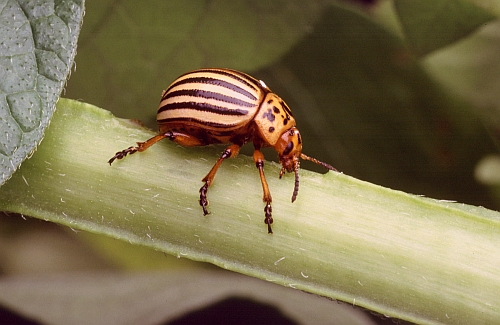
On the other hand, a tightly focused site about how to keep Leptinotarsa decemlineata and its relatives from taking over your home garden has a chance of making it to the top three pages. If I wanted to invade that niche, I'd create something useful to the general public, with good pictures and maybe a bit of humor. It would follow good coding practices for the search algorithms, of course.

I'd have almost no competition at all for a page with the specific keywords "kill potato beetles" ... that's what most gardeners want to do to them. I hear the ads for insecticides pay pretty well too.
Potato Beetle courtesy USDA photo archives
Leptinotarsa decemlineata ... the Colorado potato beetle.
Photo from the USDA photo archive.
Read more!