Showing posts with label herbicides. Show all posts

Monday, June 18, 2018

Killing Trees That Sprout From the Roots

All It Takes Is Patience, Herbicide (optional) and a Shovel


Black locust, (Robinia pseudoacacia),  Tree of Heaven, (Ailanthus altissima), and a few other shrubs and trees are notorious for coming back from the roots if you cut the main plant. In the wild they make large thickets, in the landscape they make a mess.

We removed a cluster of volunteer Ailanthus trees because they were wrecking the fence, endangering the neighbor's power lines and providing too much shade on the flower bed.

The First Attempt: Because I had heard horror stories about how hard these are to kill, I went 100% forest service style for removing them.  It involves hacking into the trunks with a hatchet and promptly applying glyphosate to the cuts at the "right time of year" to translocate the herbicide for an efficient kill.

It worked, they died that summer, and I had someone remove the trees down to stump level.  They are currently hidden by flowers, quietly rotting away and sprouting many inedible mushrooms. 
Ailanthus Stumps

Read more!

Friday, May 12, 2017

Weed Control: Herbicides 101, What Plants They Kill


Herbicides are chemicals used to control unwanted plants. All conventional or "organic" herbicides work by somehow interfering with plant growth. They may block photosynthesis and protein production, dry out the leaves, or destroy or inhibit root formation. Because different plant groups have different biochemical pathways, some herbicides can kill only one group and leave other groups unaffected. Other herbicides will kill a wider range of plants.

This means that you might be able to get rid of some plants and not kill the plants you want to keep.  But it also means you have to take the time to find the right herbicide, read labels and apply the herbicide correctly.
WARNING: If something will kill "weeds", it might also kill "flowers", "lawns", "vegetables", "shrubs", "trees", "animals", and you.
Read the labels before you buy a product or open the container. Follow the instructions. What has been sprayed can't be unsprayed.

READ THE LABELS: Yes, that means YOU!

A typical herbicide label has several pages of cautions and warnings and instructions.  The label will tell you how to safely handle the product, what plants to use the product on, and just as important, what not to use it on. You can read the labels online while you are deciding which product you need.
Label from typical lawn weed killer.
They tell you what NOT to apply it to because it will kill those plants.

There is also a long list of weeds it has been tested against that it will kill
if you apply it according to the package directions.

What are you killing, and for how long do you want it dead?

Classified by results, herbicides can be thought of as soil sterilizers, broad spectrum herbicides, broad-leaf herbicides, grass herbicides, and pre-emergent herbicides.  So your first step is to decide what effects you need, and identify the plants you want to kill. Then you can select which product of that class will work best for you.

Soil Sterilizer
A soil sterilizer prevents seed sprouting and regrowth from roots for a long period, months to years.  It usually kills existing plants as well.  This is the equivalent of "nuke it from orbit" for a gardener, and should be very carefully researched.

This is not the product you want to apply to clear the weeds from where you plan to put a lawn or vegetable garden.

Broad Spectrum Herbicide
Affects almost every plant you spray, but will not prevent seeds from sprouting, or only has a short effect on seed sprouting. These are useful for killing off everything and replanting with the desired species. With care they can be used around established plants without harming them.

Glyphosate is in this class, as is horticultural (20%) vinegar, and that stupid mix of salt, vinegar and dish soap. 

Broad-Leaf Herbicide
Affects most plants with two seed leaves, also known as broad-leaf plants, but does not affect plants with one seed leaf, such as grass and corn. This is what you get in the herbicides to kill weeds in lawns.


TIP: Not all plants with grass-like leaves are immune to this class of herbicide.  Some are not botanically a "grass" and others are just delicate varieties of a grass.

Grass Herbicide

This affect plants with one seed leaf or thin leaves, such as grass and corn, but does not affect plants with two seed leaves. These are useful for killing grass in your shrubbery and rose beds or an orchard.

Pre-Emergent Herbicide
This is often sold as a "weed preventer" because it sounds more appealing than "pre-emergent herbicide".  However it is labelled, it will prevent most seeds from germinating, so don't try to use it to keep weeds from sprouting in the vegetable bed or lawn you just seeded.


TIP:Timing is everything with pre-emergents. Applied too early or if there is too much rain and the herbicide might be washed below the level where the seeds are germinating. Applied too late and the weeds can be too mature to be affected.

On-Line References

https://en.wikipedia.org/wiki/Herbicide

http://extension.psu.edu/pests/weeds/control/introduction-to-weeds-and-herbicides/safe-herbicide-use 

http://extension.psu.edu/pests/weeds/control/introduction-to-weeds-and-herbicides/herbicides

http://www.ocregister.com/articles/plants-80501-weed-herbicides.html  Read more!

Monday, May 1, 2017

Watching Grass Grow: What I Should Have Done for Buffalo 2.0

This is another "Oops, should have thought a bit longer" post. I realized too late that there was a slower but less work way to get the front yard growing.

I should have established the grass and wildflowers over 2 or 3 years, not just one spring, to make weed control easier.
  1. Water well, lure out and kill annual weeds by any means possible between November and May.  Flames, herbicides, tilling ... total war on weeds.
  2. Plant the buffalo and grama grass in May, with the jute erosion control mesh.  The seeds would sprout faster in the warmer weather.
  3. Get the grasses established the first summer, weeding and using herbicides as needed. Anything that is not a grass is the enemy at this time.
  4. If the weed pressure is low, plant wildflower seeds that fall and following spring. 
  5. If there are still a bazillion weeds, use a pre-emergent or  broad-leaf herbicide another year before planting wildflowers.
But, I was in a hurry, so I planted the buffalo and wildflower seeds in early spring, and the weeds took advantage of the water. They were well-sprouted before the grass even broke dormancy.

On the bright side, I have acquired excellent experience in hand-weeding large areas and recognizing weed versus wildflower seedlings.
Read more!

Sunday, April 9, 2017

Weed Control Methods: Herbicides Series

I will be publishing a series of posts on herbicides for weed control, explaining in a non-technical manner how to select the correct one for your problem and use it effectively.

It's a bit more complicated than grabbing a bottle of "weed killer" and spraying the yard.
WARNING: If something will kill "weeds", it might also kill "flowers", "lawns", "vegetables", "shrubs", "trees", "animals", and you.
Read the labels before you buy a product or open the container. Follow the instructions. What has been sprayed can't be unsprayed.
As I complete the posts, I'll update this, or click on the tag "herbicide" to see them and any other posts on herbicides. Read more!

Friday, December 16, 2016

Weed Control Methods: Flame Throwers and Weed Burners

Flame Throwers and Weed Burners

Weed burners or flamers are blowtorches adapted to deliver flames to ground level.  They do not have to burn the plants to ash as long as the heat cooks the leaves.  Flamers work best on small weeds with a high moisture content because the plant doesn't have the resources to regrow after the leaves are dead.
Too big for most of us, but a very striking photo from www.lpg-apps.org. 
Flaming the weeds on a large field before planting the crop.

Read more!

Monday, December 12, 2016

Manual Weed Control Methods: Hand Pulling and V-Weeders


There is something deeply satisfying about grabbing a fistful of weeds and yanking them out, roots and all. However, you have to make sure you aren't just pulling the leaves off because the weeds will regrow.  The soil should be damp, either from a heavy rain or recent watering.  If it's too wet you will yank out huge clumps of dirt with the weeds, and if it's too dry the roots are locked into the dry dirt.

Best Technique:  Grasp the entire plant at the base, holding all the leaves in your hand and rotate it as you pull up.  If things go right, you should pull out an intact tap root.  If you are just breaking the tops off, water the area and try again in a couple of days, or use a V-weeder.

NOTE: Most annual plants have a growth point at the base of the leaves that can regenerate leaves. Slice below this point or the weed has a chance of growing again. 
Growth point: be sure to get this and the top inch of the roots.


Read more!

Thursday, December 8, 2016

Weed Control: Know the Enemy


It's not the weeds you see that are the problem, it's the ones hiding in the dirt, waiting to grow.

Weeds in Rye
By Agronom (Own work)
[CC BY-SA 3.0 (http://creativecommons.org/licenses/by-sa/3.0)],
via Wikimedia Commons

Read more!

Tuesday, June 23, 2015

How to Kill Bermuda Grass in 10 Easy Steps

In its proper place, Bermuda grass (Cynodon dactylon) makes a good lawn or good pasture. Unfortunately it doesn't stay in its proper place. The underground roots and the above ground runners spread everywhere. Soon you have Bermuda grass erupting from your flower beds, creeping through your cactus, tangling in your shrubs and even invading your garden shed.

Killing Bermuda grass is not difficult, but it's not going to happen overnight. I'm a desert landscaper. I spend a lot of time killing lawns, especially Bermuda grass lawns, to replace them groundcovers that use less water. I have learned that no matter what the herbicide package says, it will take at least a month and several applications of herbicide to kill 90 to 95% of the Bermuda grass, then several months of spot application on surviving sprigs to get the remainder. It's a tough plant. It's so tough that it grows in the cracks of the concrete medians in the middle of a Phoenix freeway.

Bermuda Grass with seed heads
By Harry Rose from South West Rocks, Australia via Wikimedia Commons

Read more!

Tuesday, July 27, 2010

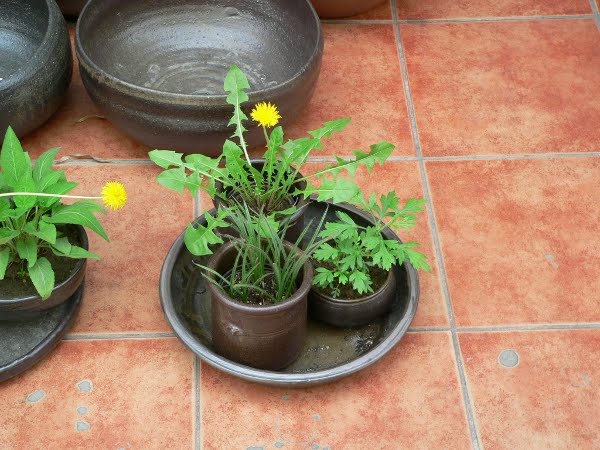
Dandelions and Clover Terrorizing Lawns Nationwide!

Through a chain of gardening blogs, I found Garden Rant's rant about the inability of Scotts Chemicals to comprehend that diversity in lawns is a good thing. To Scotts, the only good clover is dead clover, the only good dandelion is a dead dandelion, and the only good lawn is one that soaks up several hundred dollars of their product every year.

Dandelion For Sale In Seoul, Korea

Does this cute yellow flower look like it should be hunted down and poisoned to make a sterile monoculture that covers half of my property? Let's bring back the lawns of granny's time, when they were a vibrant mix of grasses, clover and a few volunteer wildflowers. Bees loved those lawns, birds loved them, children loved them, and they were easier to take care of.
Dandelion In October, White Mountains, AZ
Read more!

Monday, August 10, 2009

Watching Grass Grow: Week 20 Confessing the Mistakes

This is the post where I point out my errors, hoping you won't commit the same ones.

The weather, and some lack of foresight on my part, made the conversion go less smoothly than it might have. None of the errors were serious - in only 3 months I grew a nice lawn - but they have created more work than was necessary.

NOTE: My planting schedule was constrained by having plants shipped from Nebraska - I was caught between their earliest shipping date and my desire to get the plants here before the Arizona heat set in and made it risky to ship them and miserable to plant them. This will be less of an issue for anyone planning now because there will be resellers in Tucson and Phoenix soon.

Bermuda Grass Control: I should have started Bermuda control the previous fall, because it wasn't quite out of dormancy when we planted the buffalo grass. The heavy watering while the buffalo was being established encouraged the Bermuda. Despite spot spraying and pulling, there are still some thriving patches of Bermuda in the lawn. Unless the two grasses go into and out of dormancy at the same time (still unknown), I'll be able to spray the Bermuda with glyphosate while the buffalo is dormant.

Killing the existing Bermuda will be especially important for anyone who is planting plugs into an existing lawn without having it stripped of old sod. It requires several applications of glyphosate done while the Bermuda is well-watered and actively growing to get a good kill rate.

Annual Weed Control:
Applying broadleaf weed killers in Arizona is controlled by the temperature - despite being for "broad-leaved weeds", the herbicides will damage turf grasses if they are applied when it's too hot. Their definition of "too hot" means spraying weeds is not an option during most of the Phoenix weed-growing season.

I should have used a pre-emergent to control annual weeds. Hand-pulling got the worst of them, but it was extremely time-consuming. Applying pre-emergent this fall and next spring should get them under control.

Soil Preparation:
The buffalo grass arrived the day before the sprinkler system was installed. Again, this would have been better done sooner than it was, to give me time to let the tilled-in compost settle, refill low spots along the sprinkler tranches, and for the first crop of annual weeds to sprout and be killed.

A lawn roller would have been useful before planting to make the soil firmer, and after planting to make sure the plugs were in solid contact with the soil.

I filled in the worst of the low spots and will touch up the levelling while the lawn is dormant.

Sprinkler Installation: I forgot to tell the installers to use 6" pop-ups, which means I have to mow the buffalo grass or it starts blocking the the water distribution.

Fortunately, they used sprinkler bodies that allow me to retrofit 6" popups without having to dig up the lawn. As soon as the pop-ups are changed out, I should be able to let the buffalo grass go unmowed.


Read more!

Monday, July 13, 2009

Watching Grass Grow : Week 16 Water Saving?

The main claim that attracted me to the UC Verde strain of Buffalo grass was the claim that it would require less water than Bermuda Grass after it was established.

Here it is, 4 months after setting out the plugs. It's a lawn, it's green, and it's not stressed by the temps hovering near the 110°F mark. It was 112° when I took the picture and scurried back onto air-conditioned safety.


And how is the water consumption? Keep reading. I updated the calculations, and it's using less than I thought it was.


Every sprinkler system is a bit different, so the first thing to do is measure the water delivered in 15 minutes. It's the "tuna can" method explained here. Small pet food cans also work. Any container that is flat-bottomed, straight-sided, and a couple inches deep will do.

Lawn Water Calculator for Phoenix. The tuna can method will also reveal any over- and under-watered spots.

After measuring how much water was in each can, I entered the measurements into the calculator. The calculator is based on watering every third day - not optimal for Bermuda, but many people have a problem watering less often. At least it's better than watering every day.

According to the calculator, if the lawn were established Bermuda, It should be watered for 15 minutes every three days. I'm watering 15 12 minutes every four days, which is only 75% 60% of the water recommended for Bermuda. Already! YAY!

The lawn is not mature - the vendor of the Buffalo grass told me it will use less as the root system goes deeper. He also said that UC Verde is the only one of the buffalo grass cultivars that truly thrives in heat. That's good, because Phoenix has had temperatures mostly above 105°F for the past couple of weeks and there's no relief in sight.
Read more!

Monday, July 6, 2009

Watching Grass Grow Week 15: Turf, I haz it!

Wow, give buffalo grass a week or two of 105°F+ (over 40°C for you metric people) with Arizona monsoon humidity and it turns into turf! Real, fine-bladed grassy lawn kind of turf!


The annual weeds are quitting faster than an Alaskan governor, and the Bermuda grass is ducking for cover like a politician caught hiking the Argentine trail. Even the spurge is being displaced.


I am watering every 4 days, which is enough to keep an established Bermuda grass lawn alive, and the UC Verde buffalo grass is green and looks and feel like a LAWN!

Even the small area that is getting less than half the water as the rest of the lawn (because the sprinklers need adjusting) is still looking like lawn. It's clearly drought-stressed, but not dead, and I fixed the sprinkler problem. It's still turf, just not tall turf.


I am hard to impress, but ... I'm impressed. If this could be sold as sod, it would be perfect, but 3 to 4 months establishing the plugs is a minor investment of time compared to the saving water and mowing time I'm going to be enjoying next year.


I'll point out where I screwed up establishing the lawn in a later post.


Read more!

Monday, June 15, 2009

Watching Grass Grow Week 12: Baby's Second Haircut

The buffalo grass responded to the first mowing by sending out a lot of side growth and getting thicker, so I mowed it again!


Weaning it off water starts real soon, when the relative humidity goes up. Right now it's getting watered every other day, so I'll go to three days, then four, increasing the length of the waterings as I decrease the number.

Read more!

Wednesday, June 3, 2009

Watching Grass and Weeds Grow: Week 10

This week I have some comparison photos. I took these by standing at the edge of the patio, with the camera pointed straight down.

March 24, 2009 is really wimpy. It's a few days after planting.


April 27, 2009 is not much better, and the weeds are sprouting.


May 21, 2009 is starting to look like it might be a lawn. The runners are criss-crossing the bare patches and starting to root.


June 3, 2009 shows it's getting dense and almost needs mowing in this spot. Not all of the lawn is like this, but most of it looks at least like the previous picture. This is only 2 1/2 months after planting the plugs at the maximum recommended spacing. There are a few weeds, but it's choking most of them out.


Read more!

Monday, May 25, 2009

Watching Grass and Weeds Grow: Week 9

It's Memorial Day. I'm sitting in the shade with a beer! We had several cool, cloudy days with light rain, which is unusual for May, and now it's back to the usual hot and dry.

The Buffalo grass continues to spread, and weeding by hand is making slow progress. The grass is spreading and rooting under the spurge where the dirt is cooler and moist all day.

Pics are coming, I promise. Read more!

Saturday, May 16, 2009

Watching Grass and Weeds Grow: Week 8

Not using a pre-emergent to prevent weed growth in a new lawn area is a major mistake, especially in Phoenix. The abundant water has encouraged astounding numbers of weeds to sprout. Arizona's warm-weather weeds are mostly waxy-leaved like spurge, or fuzzy-leaved desert plants, and herbicides aren't absorbed well. Most of the weeds barely slowed down when I sprayed them with a broad-leaf weedkiller.

Most broad-leaf weed killers can't be applied to turf grass when the temperatures are above 85°F, which happens really early in the morning in Phoenix. Some herbicides specify that the daily maximum temperature can't exceed 85, which makes them useless here.

I'm hand-weeding, which in a way is good, because in the course of pulling the broad-leaved weeds I find a lot of small surviving Bermuda grass clumps that are coming from the deep roots. Left alone, these would be huge and well-rooted in a couple of months.

The buffalograss is thriving despite the weeds. The plugs have turned into dense clumps the size of dessert plates, and there are only a few patches of dirt the runners haven't reached.
Read more!

Monday, May 11, 2009

Watching Grass and Weeds Grow: Week 7

Good grief! I had forgotten how much of a pest spotted spurge (Euphorbia maculata) can be in a well-watered area of exposed dirt. What I should have done was apply a pre-emergent, but the schedule didn't permit. Fortunately, spurge is an annual weed so I get another chance next year.

The buffalo grass is sending its runners right over the top of the ground-hugging spurge, so maybe it can choke it out.

The areas where we planted the extra plugs with 9-inch spacing has a dense mesh of runners covering the soil and spurge between the plugs, with some dense satellite clumps from the earliest runners. If your budget can handle the added cost (4 times as many plugs to plant for 9-inch spacing compared to 18-inch spacing) you could have decent coverage by mid-June with a late March or early April planting. Read more!

Monday, May 4, 2009

Watching Grass Grow and Weeds Die: Week 6

The weeds are finally starting to discolor and shrivel, and I spent half an hour tracking down and spot-spraying glyphosate on any Bermuda grass sprouts I could find. I even found a pine seedling, probably left from all the pine needles, cones, and other debris that I used to compost before the neighbors removed their overgrown trees.

I forgot to turn off the sprinkler system for the required 48 hours, which washed off the herbicide. So I had to spray again. I was so focused on getting the dosage I forgot that many herbicides are slow to penetrate the leaves.

The buffalo grass is mostly thriving. Most of the plugs are much denser, and runners are zooming out in all directions. They seem to have a built-in moisture detector, because the plugs along the edge of the sprinkled area are sending more runners towards the wet dirt than the dry dirt.

About 5% of the plugs are alive but not sending out new leaves or runners. It they don't start doing something soon the more vigorous ones will run over them. Read more!

Thursday, April 30, 2009

Buffalo Grass v.s. Bermuda Grass (what to kill)

If you are replacing a Bermuda grass lawn with buffalo grass, you will have to kill any Bermuda that survived the pre-planting attempts to kill it. There will be sprouts for several months, maybe even years, depending on how long the Bermuda Grass had to become established. You can either dig out the sprouts, removing as much of the roots as possible, or carefully spray them with a grass-killing herbicide. I'm doing both, depending on how close the Bermuda grass sprout is to the buffalo grass.

They are both grasses, and both spread by runners across the soil. So how do you tell them apart? Look at the way the leaves grow.

This is Bermuda grass. The leaves come out almost opposite to each other. As the runner gets longer, a new pair of leaves will push out of the growing tip.


This is buffalo grass. Only the leaves at the tip are paired. The leaves on the runners are not paired. The growing tip will leave one of the blades behind on the stem as the runner gets longer.


More Bermuda grass. It typically has the blades parallel to the ground, flat side up to catch as much sun as possible. The leaves are mostly in pairs.


More buffalo grass. It tends to send the sprouts upward instead of flat to the ground.


Read more!

Monday, April 27, 2009

Watching Grass and Weeds Grow : Week 5

This week I was watching the weeds. The constant moisture that it takes to get the grass to spread is encouraging a huge crop of weeds. I identify spotted spurge, wild chamomile, tomatillos*, lots of junk grasses, annual bluegrass, cranesbill and others. I don't like to use herbicides, but there are too many weeds to control by hand pulling and using the scuffle hoe would rip out the spreading grass runners.

My recommendation for anyone trying to establish a buffalo grass lawn - or any kind of lawn - would be to start in the fall. Prepare the soil then. Water it well in early spring to get the annual weeds to sprout so you can kill them with glyphosate before the grass is planted, and use a pre-emergent to get the stragglers. I didn't, for compelling scheduling reasons, and am having to compensate by applying chemicals I don't normally use.

After a lot of researching what works for buffalo grass (there is not much information yet) ... it was time for some chemical warfare against the weeds with a broadleaf weed killer that has a mix of 2, 4 D (2,4-Dichlorophenoxyacetic acid), Mecoprop (methylchlorophenoxypropionic acid), and Dichlorprop.

As usual, I read the label, used the lowest recommended dose and followed ALL the instructions carefully. Buffalo grass is reputed to be more sensitive to broadleaf weed killer than some turf grasses, especially if the herbicide is applied on a hot day. I sprayed early in the morning on a day when the highest temperature was predicted to be below 90° F. I'm now watching for the weeds to start dying.

Grass News: In a the small area we planted with 9-inch spacing to use the few extra plugs, the runners from the clumps are touching the other clumps. In the areas with 18-inch spacing, a few runners are a foot long. If your budget can handle the extra expense, I recommend buying enough plugs for 9-inch spacing.

*Perhaps tomatillos are not considered to be a weed, but a couple hundred tomatillos sprouting in the lawn takes them out of the garden vegetable category. The seeds may have been spread by birds, or were in the compost we spread. Read more!