Showing posts with label buffalo grass. Show all posts

Monday, January 7, 2019

Jute Erosion Mesh: Lawn Upholstery Part 2

It Finally Begins to Biodegrade


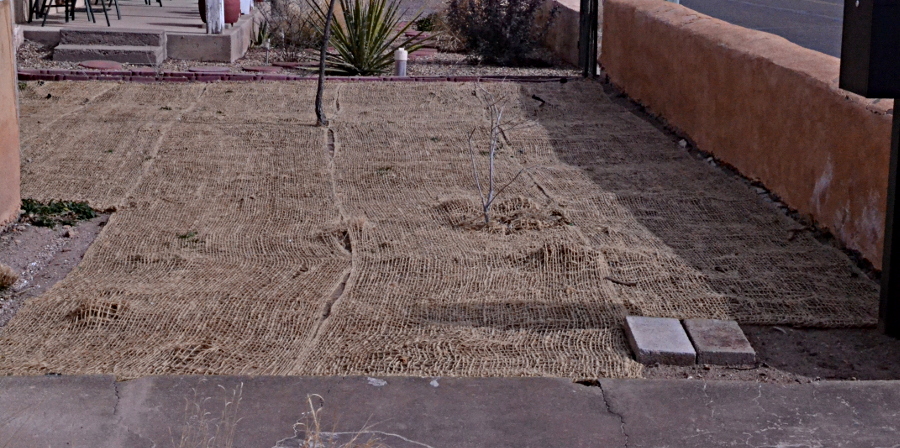
Almost 2 years ago, I covered the front yard with jute mesh to keep the grass seeds from blowing away or drying out. It worked as intended, but it's taking longer than I expected to degrade.

The mesh in the dryer areas of the yard (where the grass is thinnest) is still quite strong. The mesh where the grass was thickest has almost completely vanished. In a wetter climate, or if I had watered the grass more, it would have all vanished by now.

Raking the leaves this spring was tricky because the mesh was still strong enough to snag the rake tines. This winter the mesh is there, but although it looks intact it has most of its strength. I raked up small shreds and an occasional tangle of strings as I raked the dead grass and leaves.
The last of the erosion control cloth
 I'm tossing leaves, mesh and dead grass into the compost bins. By this time next year they will be ready for adding to the vegetable garden’s raised beds.


Read more!

Thursday, July 6, 2017

Watching Grass Grow: Buffalo 2.0 Is Now a Meadow

A meadow is grass with wildflowers ...and I have it!  At least in parts of the lawn, if you squint just right, I have fluffy clumps of grass with scattered flowers.
Jute mesh, new grass, and some wildflowers (Ratibida columnaris)
It's been slow to establish for several reasons:
  • We had a cooler spring than usual.
  • The summer rains have not come yet.
  • I did not till or amend the area before planting.
  • The seeds are not a select improved "turf" strain, it's just generic buffalo grass and blue grama grass. 
  • I fertilized very lightly and did not fertilize early.
  • Most of the wildflowers are perennials and will not bloom well this year. 
The erosion control mesh is doing exactly what I need it to do - when I water the mesh fills with water like waffles fill with syrup and it sinks in instead of running off.  I am watering daily to encourage the final grass seeds to sprout, with an occasional seep watering to get the roots to go deep.  I really need some rainstorms. Read more!

Monday, May 29, 2017

Watching Grass Grow: Buffalo 2.0 Update

Just a quick update on establishing the buffalo and blue grama lawn. It looked like this in early February, right after I spread the jute mesh and scattered the seeds.
February 2, 2017
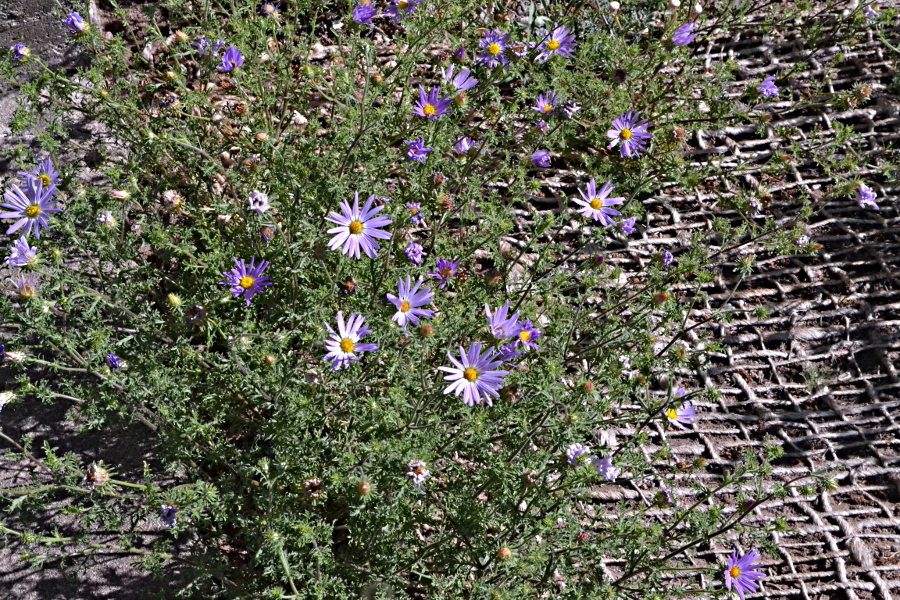
After way too much weeding and daily hand watering, by late May I had grass and an enthusiastic crop of native wildflowers.  Two annuals -  Tahoka daisy (Machaeranthera tanacetifolia) and sunflowers - are the main ones now. The perennial species are still very small.
May 27th
The daisies were not deliberately planted. They blew in from somewhere and I decided to keep them. They have a long bloom period, reseed easily, and attract a small white butterfly.
Tahoka Daisy
The native grasses don't grow very tall at first. They are establishing roots. When the summer rains come, I expect to see the buffalo grass sending out runners and the blue grama bunches get taller.
Tufts of grass
Read more!

Monday, May 1, 2017

Watching Grass Grow: What I Should Have Done for Buffalo 2.0

This is another "Oops, should have thought a bit longer" post. I realized too late that there was a slower but less work way to get the front yard growing.

I should have established the grass and wildflowers over 2 or 3 years, not just one spring, to make weed control easier.
  1. Water well, lure out and kill annual weeds by any means possible between November and May.  Flames, herbicides, tilling ... total war on weeds.
  2. Plant the buffalo and grama grass in May, with the jute erosion control mesh.  The seeds would sprout faster in the warmer weather.
  3. Get the grasses established the first summer, weeding and using herbicides as needed. Anything that is not a grass is the enemy at this time.
  4. If the weed pressure is low, plant wildflower seeds that fall and following spring. 
  5. If there are still a bazillion weeds, use a pre-emergent or  broad-leaf herbicide another year before planting wildflowers.
But, I was in a hurry, so I planted the buffalo and wildflower seeds in early spring, and the weeds took advantage of the water. They were well-sprouted before the grass even broke dormancy.

On the bright side, I have acquired excellent experience in hand-weeding large areas and recognizing weed versus wildflower seedlings.
Read more!

Monday, March 6, 2017

Watching Grass Grow: Sprouting the Buffalo Grass Seeds

Instead of waiting until nights are reliably above 60 before seeding, I'm pretending that the grass seed is in Kansas and experiencing a nice wet spring.  I'm watering it every few days, and letting the jute mesh keep it moist.  Nights here are starting to be above freezing with days in the 50s and 60s and even 70s, so it should be happy to sprout.

(Feb 21)  3+ weeks after scattering seed and upholstering the lawn, a few days of rain, a couple days of snow, and temps ranging from highs of 45-75 and lows of 25-45 I have grass sprouting. 
 Tiny little shoots, but it's grass.
I don't know if this is buffalo grass or blue grama.
I also have weeds and perhaps some of the wild flower seeds are sprouting.  This area will take some time to sort out. Read more!

Thursday, February 23, 2017

Jute Erosion Mesh As a Seed Cover

Lawn Upholstering? 

Jute erosion control mesh is not burlap - it's a fabric woven with extremely coarse yarn and large holes.  The mesh is commonly used for erosion control along new road construction while grasses and shrubs are being established. It is biodegradable, and within a couple of years, maybe more in a dry area, will decay and turn into organic material in the soil.

I'm using it like a mulch to protect newly scattered buffalo and blue grama grass seed and native wildflower mix. It should prevent my seeds from blowing away, discourage seed-eating birds and hold moisture.  It is definitely weed-free, which my compost is not.  It supposedly decomposes in a couple of years, so I will write more than this post about how it works.
Upholstered Lawn

It does look like I carpeted the lawn, and the neighbors are looking at me funny.
Read more!

Wednesday, February 15, 2017

Watching Grass Grow: The Return of the Buffalo

We had heat-tolerant buffalo grass in Phoenix and loved the low maintenance and toughness of it.  The landscape plan in New Mexico includes a xeriscape "meadow" of grasses and wildflowers.  Instead of the plugs, I'm using seeds of a buffalo grass variety better adapted for high desert, mixed with blue grama grass and a small number of other native grasses for accents.
Buffalo cow and calf enjoying a stroll in Yellowstone National Park

The front yard was mostly neglected bare dirt. After the visible weeds were killed off, the seeds were scattered over the bare dirt and covered with jute erosion control mesh as a mulch to keep the seed from blowing all the way to El Paso. When the weather warms up, I'll be watering every few days until the grass is established. I'll also be pulling weeds.

Seed Sources

Western Native Seed of Coaldale Colorado
Xeriscape Lawn Mix, 70% buffalo grass/30% blue grama grass
Because the grama grass seeds are smaller than the buffalo grass, it's probably equal quantities of each seed.
Xeriscape Wildflower Mix  A whole bunch of stuff in this.

Prairie Moon Nursery was the source for some of the accent grasses and wildflowers. I'll be writing about them later.  I put about half of the grasses from prairie Moon into the main lawn mix and the rest will be planted as drifts or specimens

Also, I had grass and flower seed collected from along the roads here that I blended into the grass or flower seeds before scattering them. It will be interesting to see what grows. Read more!

Sunday, October 19, 2014

Watching Grass Grow: Week Eleventy To Mow or Not to Mow, That is the Question

 It's Fluffy!  It's Green!

I came back after a summer's absence to find that the lawn had not missed my care.  This is  what dethatching, fertilizing, and a few heavy rains can do for a lawn,  It was fluffy and green and dense.


Buffalo Grass, Sept 21, 2014,
Mowed 6+ Weeks Ago


Read more!

Friday, May 9, 2014

Watching Grass Grow: Blue Grama Grass

Another Experiment

This is a total experiment ... I over-seeded the buffalo grass with another low-care native grass from the short-grass prairies, Blue grama grass, (Bouteloua gracilis).

It's supposed to sprout in 5 or 6 days, so for a couple of weeks the lawn is getting a couple of minutes of water 3 times a day to encourage the seeds. Then we'll cut back as the Blue Grama gets established.
Blue grama. Bouteloua gracilis at Minnesota Landscape Arboretum
Photo by SEWilco from Wikimedia Commons


If it works, I'll know when we see seed heads pop up in the late summer.  The birds will love it, and maybe it will help choke out the Bermuda grass.

Blue Grama grown as an ornamental accent in Japan.

Read more!

Wednesday, May 7, 2014

Watching Grass Grow: Preventing Bald Spots


Where's the Grass-rogaine?

The buffalo grass is prone to develop bare spots, at least in this area with the watering schedule I keep. Unless you are keeping the bare soil moist, it's unlikely to fill them in with new springs.

I'm doing a week or two of short, frequent watering sessions to encourage the grass to spread. 
Dead spot where Bermuda grass died, before de-thatching.

Baldness Prevention tips:
  • Empty the mower bag before it overflows and starts dropping clumps of clippings on the lawn. Those clumps turn into bald spots.
  • Pick up fallen twigs and other debris frequently.
  • Kill weeds, especially the ones with a rosette of leaves. When they die they leave round bald spots.
  • Fill in any craters the birds dig.
  • Don't let your dogs pee on the grass. It kills the grass in that spot. 
  • If you have pop-up sprinklers, turn them on during the daytime and check the flow and alignment. Lack of water makes big bald spots.
  • Trim back bushes that overhang the sprinklers.
Read more!

Monday, May 5, 2014

Watching Grass Grow: Feeding the Buffalo


Adding Amendments

Buffalo grass does not need or tolerate much fertilizer. Mine was last fertilized when we planted the plugs in March of 2009. 

However, it does do better with some help dealing with the alkaline desert dirt.  I applied about 20 pounds of soil sulfur and 15 pounds of Ironite, sprinkled evenly over the 1200 square feet. The sulfur lowers the pH a bit, freeing minerals that are locked up in the alkaline dirt. The Ironite is because our dirt is low in iron.

I made a large shaker jar to use for applying the granular amendments. It's a recycled roasted nut jar with 3/8 inch holes drilled in half of the lid. I can weigh the jar and contents and know I'm not overdosing the grass on nitrogen. 

Upcycled, recycled, totally cheap fertilizer applicator.

TIP: Weigh out half the amendment and walk back and forth, shaking out the contents of the jar as you walk. Then sprinkle the other half, going at right angles to your first path. It gives a more even distribution. Then water the lawn thoroughly to dissolve the granules into the soil.

How much fertilizer? 

Several university websites recommend lightly fertilizing Buffalo grass with 1 lb "effective nitrogen" per 1000 square feet after the grass has greened up. A slow-release fertilizer would be best.

TIP: Apply fertilizer AFTER you see the lawn start to green up. If you apply it before then it encourages weeds, it does not speed up the process of "greening up".

http://aggie-turf.tamu.edu/aggieturf2/calculators/fertsheet.html says 5 lb of Amminium Sulfate would do it. I applied about 3 pounds last week, and may apply the remaining two pounds later.

CAUTION: Do not use the "Weed and Feed" type fertilizers that combine herbicides or pre-emergents with fertilizer. They will damage your buffalo grass lawn. 
Read more!

Sunday, May 4, 2014

Watching Grass Grow: Grooming the Buffalo


De-thatching the lawn

It's time for a makeover and spa week for the lawn. Five years after planting, some bald patches had developed, the turf was thinning, and it was looking as patchy as a shedding bison. It had a rough couple of years in 2012 and 2013 because I wasn't here to monitor the watering and mowing. And some of the Bermuda died, leaving bald spots.

Shaggy buffalo eating grass

In the wild, buffalo grass would be closely grazed by bison or cows and occasionally be burned to the ground in a grass fire. I'm going to mimic that by mowing it short and de-thatching it. For comparison, annual de-thatching is recommended for Bermuda grass.
Read more!

Tuesday, September 11, 2012

Watching Grass Grow: Buffalo Grass After Four Phoenix Summers

I haven't updated about the buffalo grass lawn because there hasn't been much to update.  It grows, it gets watered, it needs very little mowing, and it's reasonably weed free.  It hasn't been fertilized since we planted it.

We even tried to kill it, and failed.  I was out of town all spring and early summer, and I forgot to tell my roommate to set the watering frequency to every 10 days, so it went until late June on a couple of 15-minute waterings and a trace of rain. I didn't take a picture of it before the water was increased, unfortunately.  It greened up a bit, but the blades were short and a distressed-looking grey-green.  It was in survival mode, waiting for the monsoons.

Buffalo Grass: September 5, 2012
This is not meant to be a clipped formal lawn, it's a grassy meadow.


The remedy for the neglect was water - a double watering immediately to soak the ground deeply and sticking to the every 10 day schedule explained in "Calculating Buffalo Grass Watering".  It's using only half as much water as Bermuda grass. There are a couple of scanty spots, but it's recovered well.

Here it is after being resuscitated. The slightly darker patches are the !@#$@$ Bermuda grass that persists despite my efforts to eradicate it.  The buffalo grass seems to be acting as a living mulch for the Bermuda. Neither one can outgrow the other and take over.

It's been mowed twice, most recently in late July. 


Read more!

Saturday, June 5, 2010

Watering Buffalo Grass: It's not rocket surgery!

It's tough being on the bleeding edge of lawn management. For example, how long should I run my lawn sprinklers to water my buffalo grass? How often? No one knows yet, but I think I'm on the right track.

Step 1 was to find out how much water my sprinkler system delivers. The "tuna can" method as explained by the University of Arizona's agriculture department measures your lawn sprinkler's output. UC Davis has a downloadable guide for California that explains a similar method.

Step 2 was estimated from bits of information. The original research for UC Verde buffalo grass indicated that it would survive, and maybe even stay green with half the water that Bermuda grass gets. I also know that deep, infrequent watering is better for lawns.

I had the Phoenix lawn watering guide site calculate the run times I would need for Bermuda grass with my sprinkler system. If you are in California, download the UC Davis brochure and use its watering times.

I converted the number of minutes of watering into minutes per month.

Step 3, I divided the monthly watering time in half to estimate what UC Verde buffalo grass would need. During April and May I watered twice a month, delivering half the water each time. 15 days was a bit too long between waterings; the grass was clearly water-stressed before the next watering session. So I've changed to delivering 1/3 of that amount every 10 days to see if a shorter interval will help.

Calculating your own watering times:
It's not rocket surgery!

Figure out how long warm season grasses need to be watered in your area, based on your sprinkler system's water output. Convert the daily or weekly amount into a monthly watering time.

Deliver between 1/2 and 2/3 of that water every month, split into 2 or 3 watering sessions.
Read more!

Tuesday, March 23, 2010

Watching Grass Grow: 1 Year Later, It's a Lawn!

Happy birthday to my buffalo grass lawn! It was one year old on Sunday, and a long way from the sea of mud we had last year. This coming year I'll be reporting on the mowing and watering it needs to keep it attractive. it's about 80% greened up, and with the predicted warmer weather this week, it should be completely green by the first of April.


Our goal is not a putting green, our goal is a low-maintenance lawn that uses less water than Bermuda grass. This survived the abnormally hot and dry summer of 2009, and the abnormally soggy winter of 2009/10 with no problems.

I don't know about the Bermuda that I know is surviving in there - the neighboring Bermuda grass lawns went dormant and greened up simultaneously with the Buffalo grass. I'm going to have to control it with low water and neglect and some old-fashioned pulling. Read more!

Friday, March 5, 2010

Green grows my Buffalo ... already!

After a very rainy, almost freeze-free winter, it's warming up. The low temperatures have been mostly in the 50s and the highs in the mid-60s to as high as 78. With that bit of encouragement, the buffalo grass started sending up a few tiny green blades of grass. I responded by cutting them all off.


Mowing the grass short in early spring lets the sun reach the base of the plant where the new growth will come from. It trimmed off most of the dry ends, revealing a blotchy greenish lawn. By the end of March it should be all green.
Read more!

Sunday, December 20, 2009

Watching Grass Grow: It's Dead, Jim

The grass is now mostly khaki, not green. We had a 1-night cold spell and the temperature dropped to just below freezing. Apparently that's enough to trigger dormancy, because over the next week or so the green color vanished. This picture was taken December 12th.


The next question will be "How soon does it get green"? Read more!

Monday, November 23, 2009

Watching Grass Grow: Almost Thanksgiving, Still Green

As the title says, I'm still waiting for the grass to go dormant. Daytime temperatures have been in the 70s and nights about 50 for the past couple weeks. The grass is still growing, but more slowly. I'll probably mow it one more time this year.

Wayne Thorsen, Mr. Buffalo Grass, was here in early November. He doesn't know if the UC Verde cultivar will go dormant at all in this climate. It seems that I'm the on the cutting (mowing?) edge, and have the oldest UC verde lawn in the Phoenix area. Finally I'm trendy!

It's hard to photograph, but there is a faint purple tinge on the tips of the blades, which may be a sign it's going dormant. There are a few annual weeds sprouting through the grass,but nothing like the army of them we had this spring. Read more!

Monday, September 7, 2009

Watching Grass Grow: 6 Months Later

Six months into this experiment, I'm happy with the buffalo grass's performance. So are the quail.


There are still some questions about buffalo grass performance in Phoenix:
  • When will it turn brown this fall?
  • When will it green up next spring?
  • How easy or hard will getting rid of the remains of the Bermuda grass be?
  • How little water can it get and still stay reasonably green next summer?
  • What will it look like with no mowing?

The claims that have been verified, at least in my lawn, are that buffalo grass needs less mowing and less water than Bermuda grass. I have mowed the lawn 5 or 6 times since it was installed, compared to the 4 or more times a month that Bermuda grass requires. It needs less water to stay green than Bermuda grass - 40% less in my experience, perhaps even less than that next year.
Read more!

Monday, August 10, 2009

Watching Grass Grow: Week 20 Confessing the Mistakes

This is the post where I point out my errors, hoping you won't commit the same ones.

The weather, and some lack of foresight on my part, made the conversion go less smoothly than it might have. None of the errors were serious - in only 3 months I grew a nice lawn - but they have created more work than was necessary.

NOTE: My planting schedule was constrained by having plants shipped from Nebraska - I was caught between their earliest shipping date and my desire to get the plants here before the Arizona heat set in and made it risky to ship them and miserable to plant them. This will be less of an issue for anyone planning now because there will be resellers in Tucson and Phoenix soon.

Bermuda Grass Control: I should have started Bermuda control the previous fall, because it wasn't quite out of dormancy when we planted the buffalo grass. The heavy watering while the buffalo was being established encouraged the Bermuda. Despite spot spraying and pulling, there are still some thriving patches of Bermuda in the lawn. Unless the two grasses go into and out of dormancy at the same time (still unknown), I'll be able to spray the Bermuda with glyphosate while the buffalo is dormant.

Killing the existing Bermuda will be especially important for anyone who is planting plugs into an existing lawn without having it stripped of old sod. It requires several applications of glyphosate done while the Bermuda is well-watered and actively growing to get a good kill rate.

Annual Weed Control:
Applying broadleaf weed killers in Arizona is controlled by the temperature - despite being for "broad-leaved weeds", the herbicides will damage turf grasses if they are applied when it's too hot. Their definition of "too hot" means spraying weeds is not an option during most of the Phoenix weed-growing season.

I should have used a pre-emergent to control annual weeds. Hand-pulling got the worst of them, but it was extremely time-consuming. Applying pre-emergent this fall and next spring should get them under control.

Soil Preparation:
The buffalo grass arrived the day before the sprinkler system was installed. Again, this would have been better done sooner than it was, to give me time to let the tilled-in compost settle, refill low spots along the sprinkler tranches, and for the first crop of annual weeds to sprout and be killed.

A lawn roller would have been useful before planting to make the soil firmer, and after planting to make sure the plugs were in solid contact with the soil.

I filled in the worst of the low spots and will touch up the levelling while the lawn is dormant.

Sprinkler Installation: I forgot to tell the installers to use 6" pop-ups, which means I have to mow the buffalo grass or it starts blocking the the water distribution.

Fortunately, they used sprinkler bodies that allow me to retrofit 6" popups without having to dig up the lawn. As soon as the pop-ups are changed out, I should be able to let the buffalo grass go unmowed.


Read more!